Multilayer Ornamental #6: A Three-Dimensional Statement
Understanding the Architectural Depth
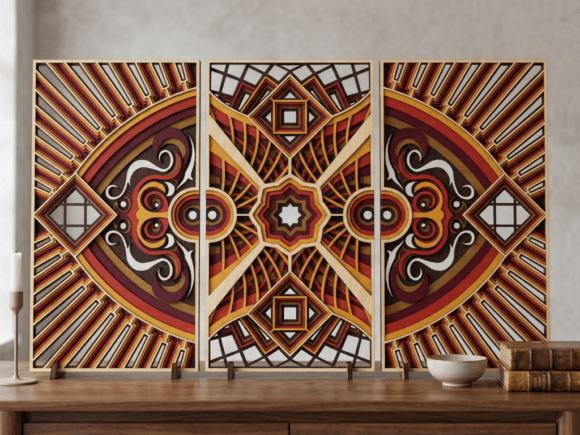
When we talk about modern decorative assets, we often discuss flat vectors and static illustrations, but Multilayer Ornamental #6 operates on a different level of complexity. This isn't just a pattern; it is a structural engineering feat designed for laser cutting and CNC routing. At its core, this design is a 6-layer multilayer triptych panel, meaning it is divided into three distinct vertical sections that work together to form a cohesive, continuous image. The goal here is immersion. By splitting the artwork into a central anchor and two extending side panels, the design creates a panoramic field of view that draws the eye across the entire surface rather than focusing on a single center point.
The visual personality of this piece is defined by bold geometry and radial motion. The central panel acts as the symmetrical focal point—a heavy, architectural anchor that grounds the composition. From there, the side panels extend outward, utilizing flowing radial geometry and intricate circular elements to create a sense of expansion. Because it is constructed from 6 individual layers, the design achieves a literal depth that flat graphics cannot. Each layer contributes to shadow transitions and dimensional separation, meaning the final result isn't just an image; it is a sculpture that interacts with light and shadow throughout the day.
Strategic Applications for Creative Professionals
As a designer, entrepreneur, or content creator, finding a design asset that bridges the gap between digital precision and physical reality is rare. Multilayer Ornamental #6 is optimized specifically for production. If you are a crafter or small business owner working with a laser cutter or CNC machine, the technical precision of these files is your biggest asset. The layers are optimized for clean, sharp cuts and seamless alignment, which means you spend less time troubleshooting assembly and more time creating. This is particularly valuable for those creating high-end packaging design or custom brand identity installations where a rough edge or misaligned layer can ruin the professional aesthetic.
Beyond the workshop, the applications for this design are surprisingly versatile. For interior designers and home stagers, a physical rendering of Multilayer Ornamental #6 serves as a dynamic architectural statement piece for lobbies, conference rooms, or modern living spaces. The "triptych" format—three panels side by side—is excellent for breaking up large, empty walls. However, the utility extends into the digital realm as well. While it is a physical asset, the underlying geometry is perfect for high-resolution web design hero images, sophisticated social media graphics, or background textures for editorial design layouts. The radial motion and symmetry provide a sense of balance and order that can elevate a brand’s perception of stability and creativity.
Visual Hierarchy and Brand Perception
In branding, the assets you choose speak volumes about your company's attention to detail. Using a complex, multilayered design like Multilayer Ornamental #6 signals a commitment to craftsmanship. When used in logo design concepts or as a backdrop for typography, the intricate geometry provides a sophisticated stage. It allows text to pop against a textured, dimensional background without being visually chaotic. The "ornamental" aspect suggests tradition and artistry, while the clean, laser-optimized lines suggest modern technology and precision. This duality makes it an excellent choice for brands in the architecture, luxury goods, or creative tech sectors.
When integrating this into a broader visual system, consider how the "layers" concept translates to your other design assets. Just as the panels create a unified sculptural effect, your marketing materials should feel cohesive. If you are using a premium font for your headlines, ensure it carries the same weight and geometric precision as the ornamental panels. For instance, pairing this design with a bold, geometric sans serif font can emphasize the modern architectural feel, while a classic serif font might highlight the ornamental, traditional roots of the symmetry. The goal is to create a dialogue between your typography and your imagery.
Practical Guidance for Production and Integration
Before you hit "cut" or "print," there are a few practical considerations to ensure the success of your project. First, remember that Multilayer Ornamental #6 is fully scalable. This is a crucial feature. Whether you are creating a small desktop ornament or a massive wall installation, the vector nature of the design ensures that the lines remain crisp. However, you must adjust your material thickness settings relative to your chosen size. A massive wall piece will require thicker, sturdier layers to maintain structural integrity, whereas a smaller piece can utilize thinner, more delicate materials to emphasize fine details.
When evaluating the fit for your project, look at the "personality" of the radial geometry. It is bold and commanding. If your project requires a subtle, whisper-quiet background, this design might be too dominant. It works best when it is allowed to be the focal point. For those using this in a mixed-media context—perhaps combining it with handwritten fonts or script fonts—ensure there is enough contrast. The rigid geometry of the panels can provide a beautiful anchor for the fluidity of a script, but you need to manage the spacing carefully to avoid visual clutter.
Finally, consider the commercial licensing and the context of use. Whether you are selling the physical finished product or using the design as part of a larger client project, understanding the scalability and the "visual reference" nature of the product images is key. The final size and proportions are in your hands, giving you the creative freedom to adapt Multilayer Ornamental #6 to fit the specific narrative of your brand. By respecting the technical precision of the layers and leveraging the immersive 3D effect, you can transform a standard project into a professional, high-impact visual experience.